

How Should a Mastectomy Bra Fit? Comfort, Security & the 5-Movement Fit Test
A well-fitting mastectomy bra should feel secure without feeling restrictive. The band should stay level, the straps should remain comfortable, the cups should contain what they need to contain, and—if you wear a breast form—it should stay where you want it as you move.

How should a mastectomy bra fit? Close enough to feel stable, but not so tight that it creates uncomfortable pressure.
The band should stay relatively level around your body rather than riding up. Straps should stay on the shoulders without digging in. Cups should lie smoothly without obvious gaping or compression. If you wear a breast prosthesis, the bra and pocket should hold it in the position you prefer when you sit, walk, reach and bend.
Fit can change during recovery, so the size that works today may not remain your size permanently.
Bra sizing gives you a useful starting point.
But it does not tell you the whole story.
Two bras with the same size printed on the label can behave very differently on the body. One band may stretch more. One cup may be deeper. One side panel may sit higher beneath the arm. A breast prosthesis may sit securely in one pocket and feel noticeably less stable in another.
That is why a useful mastectomy bra fitting needs more than a measurement.
It needs movement.
And it needs your feedback.
What Should a Comfortable Mastectomy Bra Fit Feel Like?
A comfortable fit should feel stable enough that you are not repeatedly adjusting the bra, but gentle enough that you are not thinking about pressure all day.
A useful starting check is:
It should sit relatively level around your body instead of climbing upward at the back.
They should not continually fall from the shoulders or leave painful pressure marks.
They should provide enough room without obvious gaping, folding or excessive compression.
The bra—and breast form if you wear one—should stay reasonably stable as you go about normal activities.
“Secure” does not mean painfully tight.
And “comfortable” does not mean loose enough that the bra shifts every time you raise an arm.
Good fit lives between pressure and movement.
The bra needs enough stability to stay where you want it without making your body work around the bra.
Band: Secure, Not Restrictive
The underband is one of the most important parts of bra fit because it helps anchor the bra around the body.
From the front and back, it should look reasonably level rather than noticeably rising toward the shoulder blades.
If the band rides upward, the bra may be too loose, too stretched, or simply the wrong shape for you.
If it leaves painful pressure, makes breathing feel uncomfortable or presses against a sensitive surgical area, it may be too restrictive for your current needs.
During recovery, swelling can also temporarily change your measurements.
Breast Cancer Now notes that breast and body shape can continue changing for months after surgery and treatment. That means an old bra size should be treated as a starting point, not permanent proof of what fits now.
Straps: Stable Without Digging Into Your Shoulders
Shoulder straps help position the cups, but they should not be doing all the work of supporting the bra.
If you continually tighten the straps to stop the bra riding up, the problem may actually be the band.
A well-adjusted strap should stay in place without repeatedly slipping and without digging painfully into the shoulder.
Breast Cancer Now's general bra-fit guidance suggests that you should be able to fit roughly two fingers under the strap at the shoulder as a comfort check.
If you wear a breast prosthesis, strap tension may become more noticeable because the bra is also managing the form's weight.
Compare both shoulders.
If one strap needs to be dramatically tighter than the other, look at the cup, pocket and breast-form position before simply tightening further.
Cup Coverage: Enough Space Without Gaping or Compression
Cup fit depends on what the cup needs to contain.
After a single mastectomy, one side may hold a remaining breast while the other contains a breast prosthesis.
After bilateral mastectomy, both cups may contain breast forms—or you may choose not to wear forms at all.
After partial breast surgery, the cup may hold a combination of natural breast tissue and a partial prosthesis.
This is why cup letters alone do not tell the complete story.
Look at the result.
Put a top over the bra when checking.
A plain fitted shirt can make it easier to see whether the silhouette looks and feels the way you want.
Pocket and Breast Form Position: Check the Bra and Prosthesis Together
If you use a breast prosthesis, fit is no longer only a relationship between your body and bra.
The breast form becomes part of the system.
Breast Cancer Now recommends taking a well-fitting bra to a prosthesis fitting so you can see how the form actually sits inside it.
Check whether the prosthesis sits at the height you prefer rather than riding noticeably upward or drifting toward the side.
If you use a pocketed bra, make sure the pocket opening is large enough to insert the form without forcing or folding it.
Then check the pocket after movement.
A breast form that looks perfectly positioned while you are standing still may behave differently when you walk or reach for something.
Breast prosthesis fit is not only about matching size. It is about position, movement and how the form works with your clothes.
Bring the bra, breast form and clothing together when assessing the result.
For a deeper explanation of shapes, weights and prosthesis fitting, continue to the Breast Prosthesis Guide .
Underarm Coverage: More Is Not Always Better
Fuller side panels are common in post-mastectomy bras because they can help contain the cup and prosthesis.
But high side coverage is only helpful if it feels comfortable.
If surgery or lymph-node procedures affected the underarm area, you may be especially aware of seams and side-panel height.
Lift and lower your arm gently if your stage of recovery allows it.
Ask whether the edge rubs, digs into the underarm or folds when you move.
If it does, simply choosing an even higher-coverage bra is unlikely to solve the problem.
You may need a different cut, cup position or size.
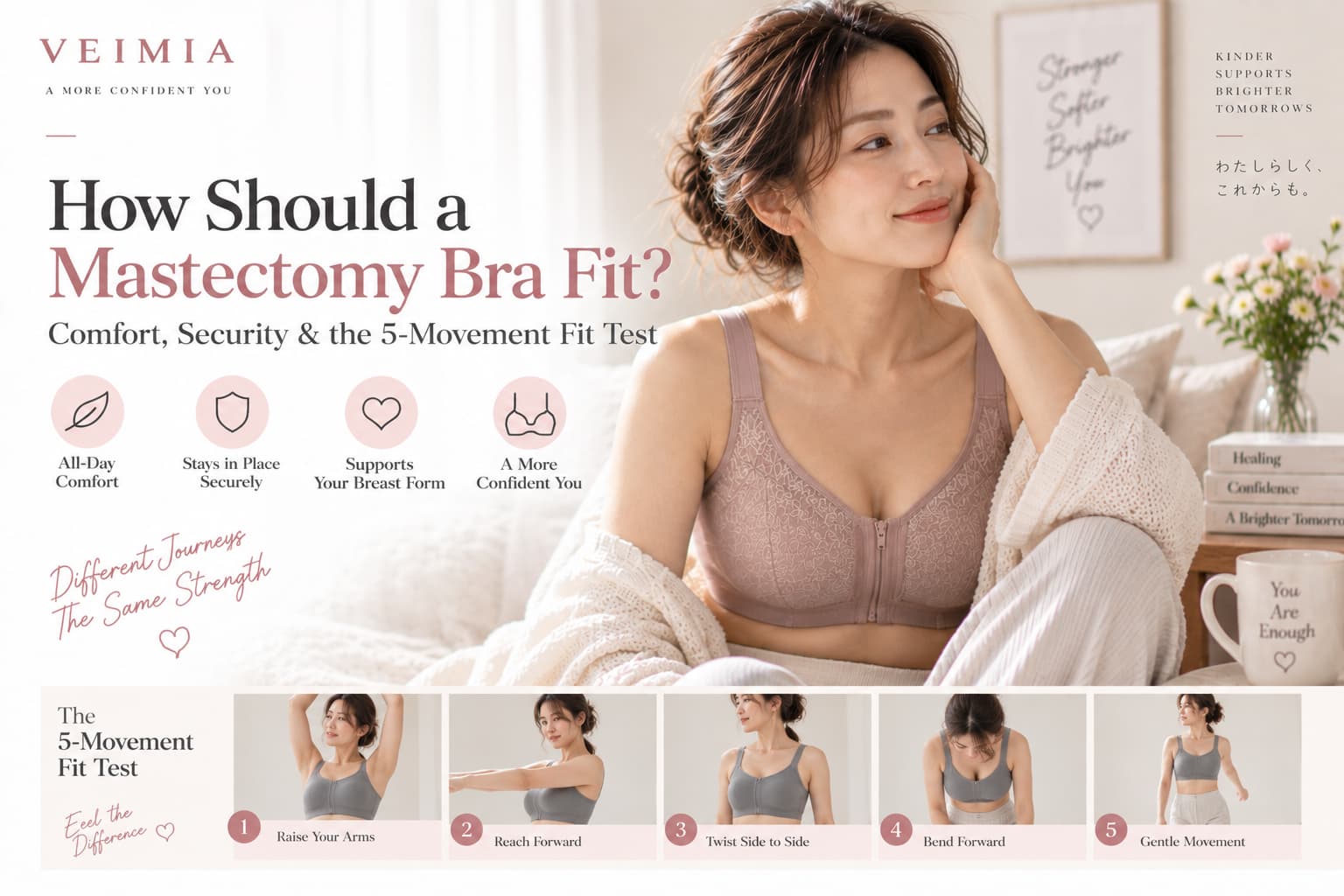
The 5-Movement Fit Test
Standing in front of a mirror tells you only part of the story.
Before deciding that a bra fits, try five ordinary movements.
Sit · Raise Arms · Walk · Reach · Bend
If you are still recovering from surgery, only perform movements your healthcare team has said are appropriate for you.
Does the band stay comfortable or suddenly press into your chest or ribs?
Does the bra ride upward? Does the breast form move noticeably?
Do the straps stay in place? Does the cup or prosthesis bounce or shift more than you want?
Does side coverage rub the underarm or does the pocket change position?
Does the breast form remain contained when you lean forward?

Breast Cancer Now's general bra-fitting guidance similarly suggests checking whether the bra remains in place when the arms are lifted.
For prosthesis wearers, the same movement check gives you another piece of information: whether the bra holds the breast form securely enough for your routine.
Warning Signs the Bra Is Not Working for You
A bra does not need to create severe pain before you are allowed to decide it is not working.
Recheck the fit if you notice:
Some problems can be fixed with a size or strap adjustment.
Others indicate that the bra shape simply does not suit your body or breast form.
Do not assume that because a bra is labelled “mastectomy” it must therefore fit every mastectomy body.
Use a Size Checklist—Then Confirm It on Your Body
Measurements are useful because they narrow the starting range.
But measurements should lead to a fitting check, not replace one.
Mastectomy Bra Size & Fit Checklist
Do not automatically rely on the bra size you wore before surgery or treatment.
Sizing systems and garment stretch differ between brands and styles.
If you use a prosthesis, the cup fit should be assessed with it in place.
A bra should not depend on over-tightened straps to stay in position.
Check the silhouette and breast-form position under clothing you actually wear.
Sit, raise your arms, walk, reach and bend before deciding.
This is where the new Pinkbook mastectomy-bra content reconnects with ordinary bra-fit expertise.
Continue to the VEIMIA Bra Size Hub for broader measurement and sizing guidance.
What Does a Fit-Focused Pocketed Bra Look Like?
The following VEIMIA style is included as one example of how several fit features can appear together. It is not presented as a universal fit solution, and the size chart should still be followed rather than assuming your usual size.
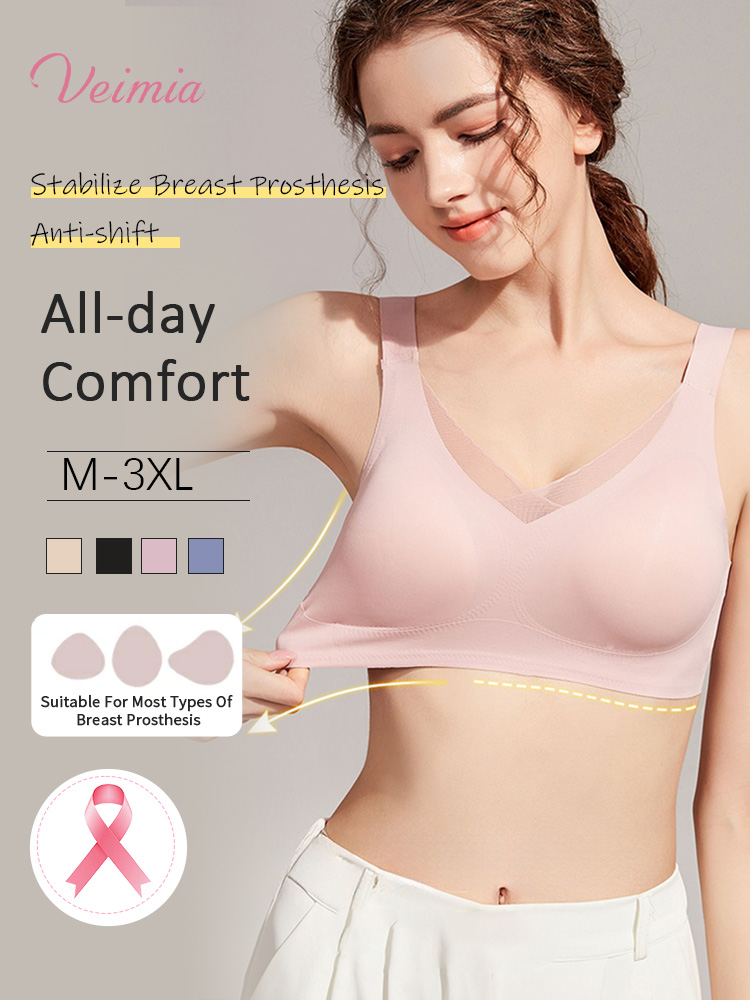
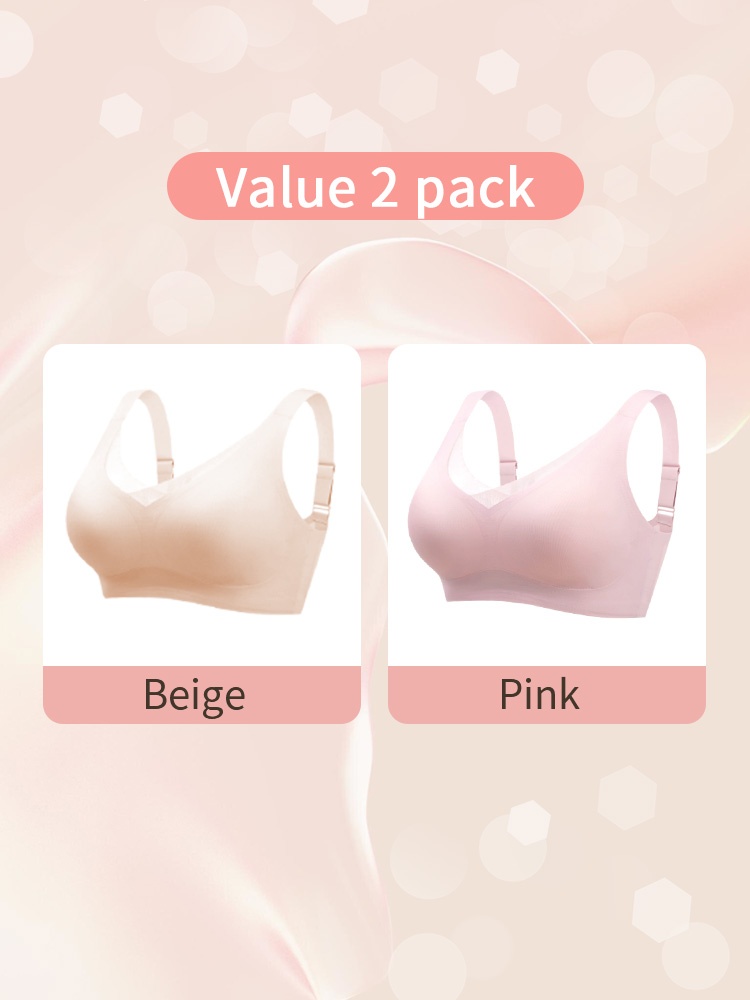
VEIMIA All-day Comfort Mastectomy Bra
This style combines a dedicated prosthesis pocket with adjustable straps, wireless construction and a back closure, making it a useful example for checking how pocket position, strap tension and everyday movement work together.
Current SG listing: S$35
- Dedicated breast prosthesis pocket
- Adjustable shoulder straps
- Wireless construction
- Seamless design
- 3-row back closure
- Current listed sizes: M–3XL
This is one fit example rather than a promise that one bra shape suits every body or breast form. Check the current product size chart and perform your own movement test. Price and availability may change.
View Fit DetailsA Good Fit Should Let You Stop Thinking About the Bra
It is easy to turn bra fitting into a search for visual perfection.
Is the silhouette completely symmetrical?
Is every edge invisible?
Does the prosthesis look exactly like a natural breast?
Those questions may matter to you.
But comfort is also a meaningful result.
A bra that stays in place.
Straps you stop noticing.
A breast form that does not need constant adjusting.
An underarm edge that does not rub.
The ability to get dressed and move into the rest of your day.
A good fit is not the bra you notice most. It is often the one you can stop thinking about.
Secure enough to move. Gentle enough to live in.
From VEIMIA Bra Fit & Pinkbook
→ Bra Size Hub → How to Choose a Mastectomy Bra → Breast Prosthesis Guide → Pocketed Mastectomy Bra GuideHow Should a Mastectomy Bra Fit? Frequently Asked Questions
How should a mastectomy bra fit?
A mastectomy bra should feel secure without being painfully restrictive. The band should stay relatively level, straps should remain comfortable, cups should sit smoothly, and a breast form should remain reasonably stable during everyday movement.
How tight should a mastectomy bra be?
Unless your healthcare team has prescribed specific compression, the bra should feel close and stable rather than painfully tight. The band should not create uncomfortable pressure on healing or sensitive areas.
How should the band of a mastectomy bra fit?
The band should stay relatively level around the body and provide enough stability that the bra does not repeatedly ride upward. It should not feel painfully restrictive.
How should mastectomy bra straps fit?
Straps should stay on the shoulders without repeatedly slipping or digging in. They should help position the cups rather than being tightened excessively to compensate for a loose band.
How should a breast prosthesis fit inside a bra?
A breast prosthesis should sit in a position and shape that feel right to you, with enough cup room and support to remain reasonably secure when you walk, reach, sit and bend.
Should a breast form move inside a mastectomy bra?
A small amount of natural movement may occur, but the breast form should not repeatedly ride upward, fall outward or require constant repositioning. If it does, check the cup, pocket, band and breast-form fit together.
How can I tell if my mastectomy bra is too big?
Possible signs include the band riding upward, cups gaping, straps slipping repeatedly or a breast prosthesis moving more than you want. Adjustments may help, but you may also need a different size or bra shape.
How can I tell if my mastectomy bra is too small?
Signs can include painful band pressure, cup compression, uncomfortable underarm rubbing, deep strap pressure or difficulty comfortably containing the breast or prosthesis.
Should I use my old bra size after mastectomy?
Treat your previous size as a reference rather than an automatic answer. Surgery, swelling, treatment and weight changes can alter measurements and bra fit, so it is useful to recheck your current size.
Medical note: This article provides general bra-fit education and does not replace post-operative instructions. Reconstruction, wound healing, swelling, lymph-node surgery, radiotherapy and other treatment factors can affect what fit or support is appropriate. Follow advice from your surgeon or breast care nurse during recovery.