

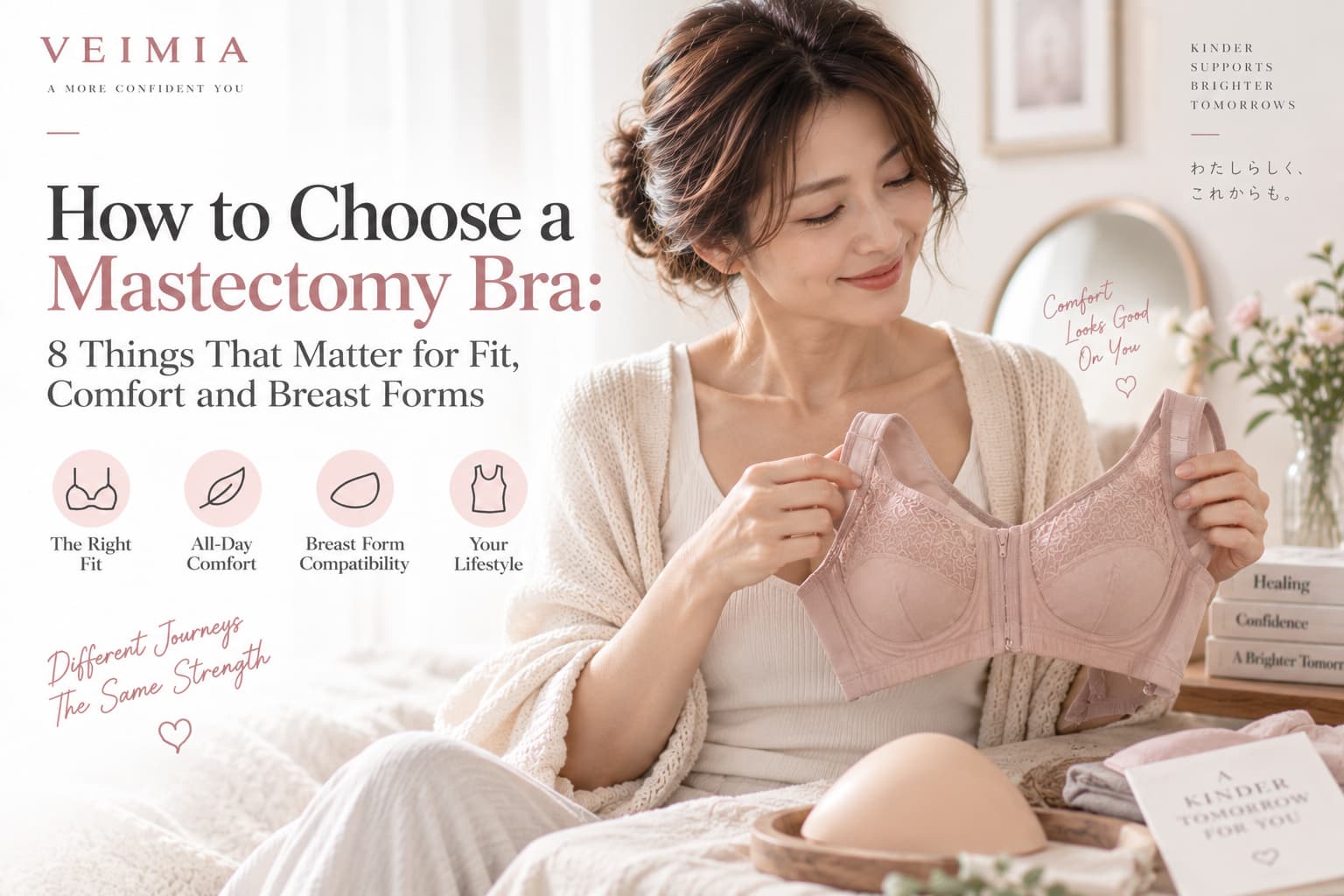
How to Choose a Mastectomy Bra: 8 Things That Matter for Fit, Comfort & Breast Forms
The best mastectomy bra is not one universal style. A more useful approach is to look at your skin, breast-form needs, movement, climate and daily routine—then choose the features that solve those needs.
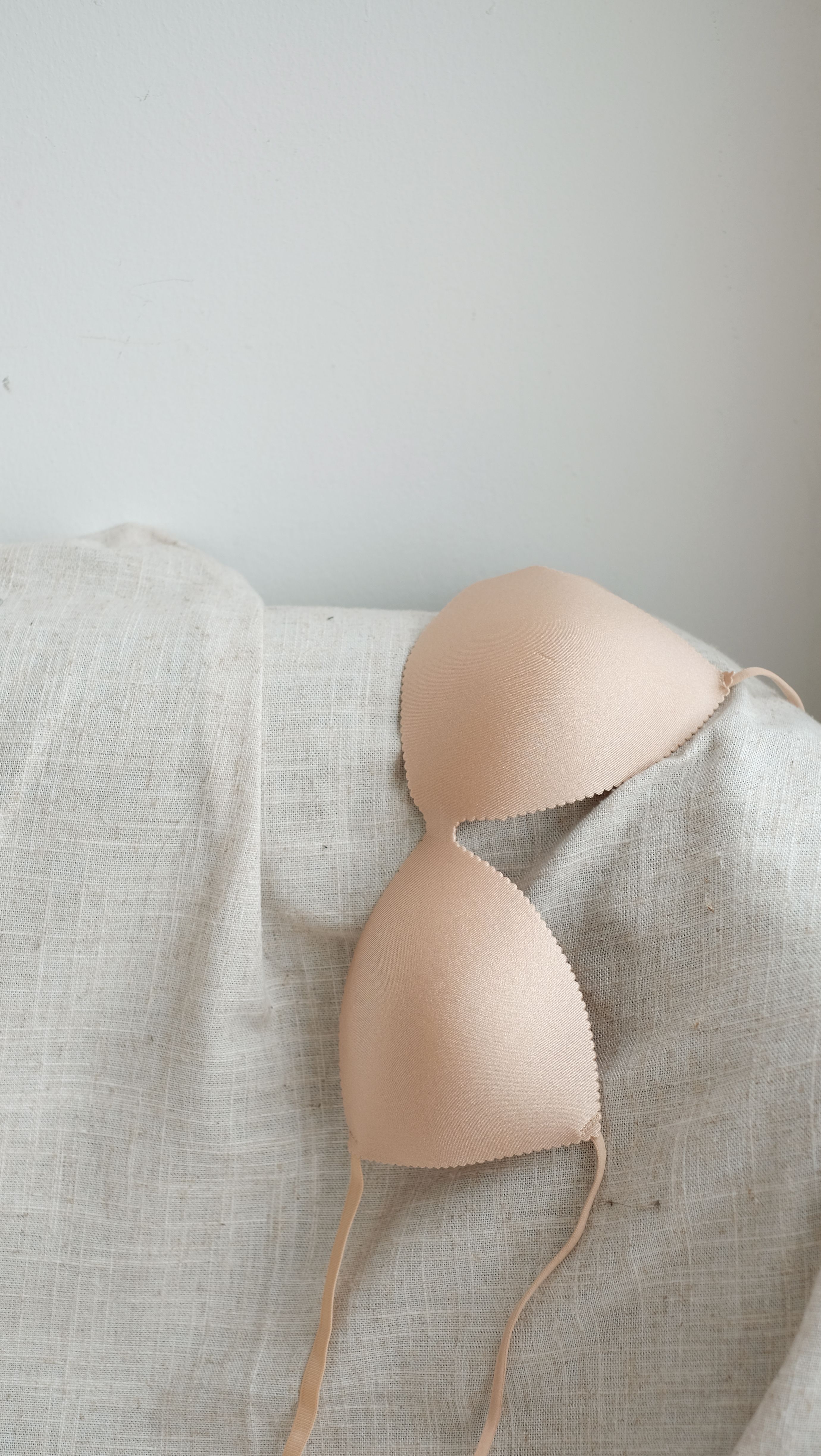
To choose a mastectomy bra, begin with what your body needs—not with a “best bra” list.
Look at eight practical areas: skin comfort, pocket design, coverage, band pressure, strap stability, closure, breathability and everyday movement. If you wear a breast prosthesis, check how securely the bra holds it. If you do not use a breast form, a pocket may not matter at all.
During active surgical recovery, your surgeon or breast care team's instructions come first. The criteria below become especially useful when you are choosing ongoing everyday bras after healing has progressed.
Searching for the best bra after mastectomy often produces a long list of products.
But product lists can miss the most important question: best for what?
Someone with limited shoulder movement may care most about how easily a bra opens. Someone wearing a silicone breast form may prioritise pocket security and strap stability. Someone with sensitive skin may care far more about the inner lining than the outer appearance.
In Singapore or Malaysia's warm, humid climate, breathability may also move much higher up the list.
This is why choosing by need is usually more useful than choosing by popularity.
What Should You Look for in a Mastectomy Bra?
Check seams, lining and anything that sits directly against sensitive areas.
If you wear a breast form, check opening size, placement and security.
Consider cup depth and side coverage without assuming more fabric is always better.
The underband should support the bra without creating unwanted pressure.
Look for straps that stay comfortably positioned and can be adjusted as needed.
Front closure may simplify dressing; back closure can offer familiar adjustment.
Fabric and construction matter when the bra is worn for hours in warm weather.
Test sitting, walking, reaching and bending rather than judging fit only in a mirror.
Skin Comfort Comes Before Styling
After breast surgery, areas of the chest may feel numb, tender, hypersensitive or simply different from before.
This makes the inside of the bra unusually important.
Run your fingers over the lining rather than judging softness only from the outer fabric. Feel where seams end. Notice labels, lace edges, pocket openings and the elastic around the band.
Breast Cancer Now suggests looking for soft seams and notes that bras with a high cotton content may feel gentler while skin is healing and can also feel cooler during hot flushes.
For longer-term wear, skin comfort becomes more personal. Some people prefer very smooth seamless interiors. Others specifically like cotton against the skin.
Check the Pocket Design If You Wear a Breast Form
A prosthesis pocket is one of the defining features of many mastectomy bras, but simply having a pocket does not tell you whether it works well with your breast form.
Look at where the opening sits and whether it is wide enough to insert the form comfortably.
Once the form is inside, check whether it sits at the height you want and whether the pocket keeps it contained when you move.
If you wear different breast forms—perhaps a lighter one for certain days—check whether the pocket accommodates those variations.
A pocket is valuable when it makes your breast form easier to wear—not simply because it makes the bra sound more specialised.
A well-fitting regular bra can also work with some breast forms, so use the pocket because it solves a need.
If you are still learning how breast forms differ, visit the Breast Prosthesis Guide .
Coverage Should Feel Secure Without Feeling Like Armour
Full cups and deeper side panels are common features in post-surgery and mastectomy bras.
Extra coverage can be useful when you want a breast form fully contained or prefer a more secure feel around the chest.
But more coverage is not automatically more comfortable.
If surgery extended toward the underarm, a high side panel may rub an area that remains sensitive. A neckline that is too high may also show under clothes you actually enjoy wearing.
Check coverage while wearing one of your normal tops.
The aim is enough structure for your needs—not the maximum amount of fabric available.
Band Pressure Matters Because the Band Anchors the Bra
The underband does much of the work of holding a bra in position.
If it is too loose, the bra may ride upward and a breast form can become less stable. If it is too tight, you may notice pressure, marks or discomfort.
During early healing, swelling can also temporarily change your measurements. Breast Cancer Now notes that bra size and body shape can change after treatment, which is one reason to reassess fit rather than assume your old size will remain constant.
When trying a bra, breathe normally, sit down and move around.
A band that feels acceptable during a thirty-second fitting may feel very different several hours later.
Strap Stability Becomes More Noticeable With a Breast Form
Straps should help keep the upper part of the bra stable without carrying all of its weight.
Adjustable straps are useful because they let you change the position as your body, bra and breast-form setup changes.
Wider straps may feel more comfortable for some people, especially when the bra is supporting additional breast-form weight, but width alone does not guarantee comfort.
Check whether the straps dig into your shoulders, slide repeatedly, or create noticeably different tension from side to side.
Choose a Closure You Can Actually Use Comfortably
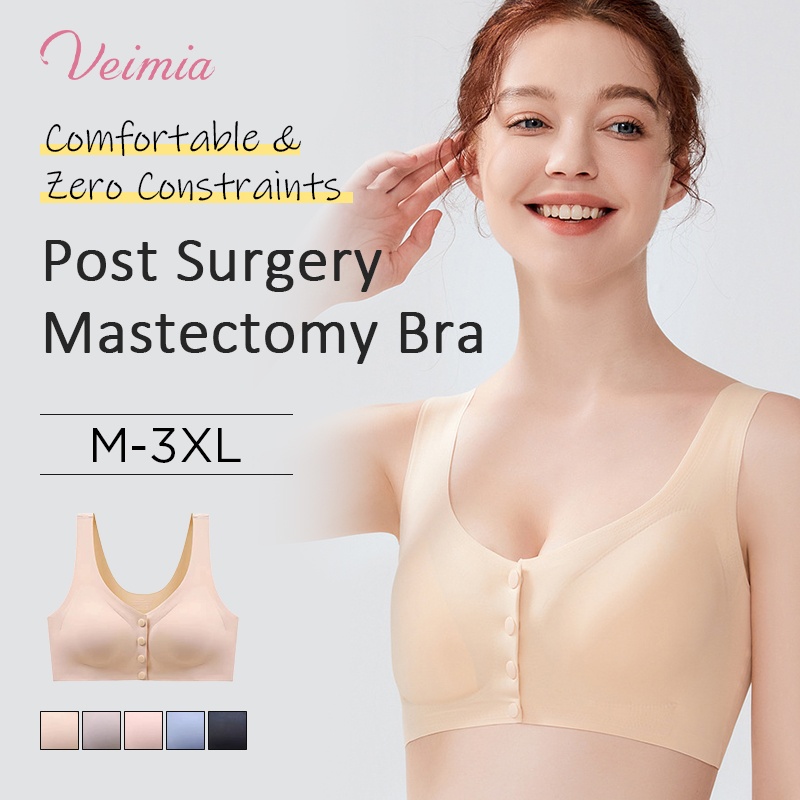
Front fastening can be especially useful when shoulder stiffness makes reaching behind the body difficult.
Breast Cancer Now specifically notes that a front-fastening bra may be easier to put on during early recovery when shoulder movement is restricted.
Later, the decision may simply come down to preference.
None is universally superior. Match the closure to your movement and dressing habits.
Breathability Matters More in Warm, Humid Daily Life
A bra can feel soft and comfortable in an air-conditioned room but noticeably warmer after a commute, outdoor lunch or full workday.
In Singapore and Malaysia, that makes airflow, fabric thickness and moisture management practical considerations rather than marketing details.
Cotton can feel comfortable against sensitive skin, while lightweight performance fabrics can also help a bra feel less heavy.
Instead of assuming one fibre is always best, ask how the complete garment feels after several hours.
Our dedicated Mastectomy Bra Climate Guide explores this in more detail.
The Final Test Is Everyday Movement
Do not finish your fitting while standing still.
Sit.
Walk.
Lean forward.
Reach gently if your recovery stage allows it.
If you use a breast prosthesis, check whether the form remains where you want it. Notice whether the bra rides upward, the pocket twists or a side panel begins to rub.
The most comfortable mastectomy bra is not simply the one that feels soft when first put on.
It is one that continues to work when you are living in it.
Fit is not a photograph. It is what happens when your body moves.
A useful bra should work while you sit, walk, dress, travel and get on with the rest of your day.
Choose by Need, Not by “Best”
A ranking assumes everyone is solving the same problem.
They are not.
A woman who wants easier dressing may reasonably choose a different bra from someone whose priority is cotton lining. Someone who already dresses easily may care more about prosthesis stability throughout a long workday.
Start with the need. Then look for the feature.
These examples show how different bra structures can solve different problems without declaring one style universally better.
| Your Need | Prioritise | Useful Feature Example |
|---|---|---|
| Easier dressing | Closure + movement | Front fastening that is easy to see and reach |
| Sensitive skin | Inner fabric + seams | Soft lining, smooth interior, cotton where preferred |
| Breast-form security | Pocket + cup fit | Dedicated prosthesis pocket with enough cup depth |
| Long daily wear | Pressure + stability | Stable band, adjustable straps and smooth construction |
| Warm weather | Breathability | Lightweight, breathable fabrics and less bulky construction |
| Underarm sensitivity | Coverage | Side coverage that feels secure without rubbing |
| No breast form | Comfort + fit | A prosthesis pocket may not be necessary at all |
How Different VEIMIA Mastectomy Bras Match Different Priorities
These are not ranked from best to worst. Each is included because its current structure illustrates a different way to apply the eight-point checklist.
VEIMIA Seamless Front Closure Mastectomy Bra
This example puts the closure decision first. Front fastening can be useful when reaching behind the body feels inconvenient, while built-in breast-form pockets add flexibility for prosthesis wear.
Current SG price: S$29
- Front closure
- Breast prosthesis pockets
- Wireless construction
- Seamless design
- Wide elastic straps
Consider this structure when easier dressing is a priority. A front closure is a convenience feature, not a universal requirement after mastectomy.
View Front Closure Option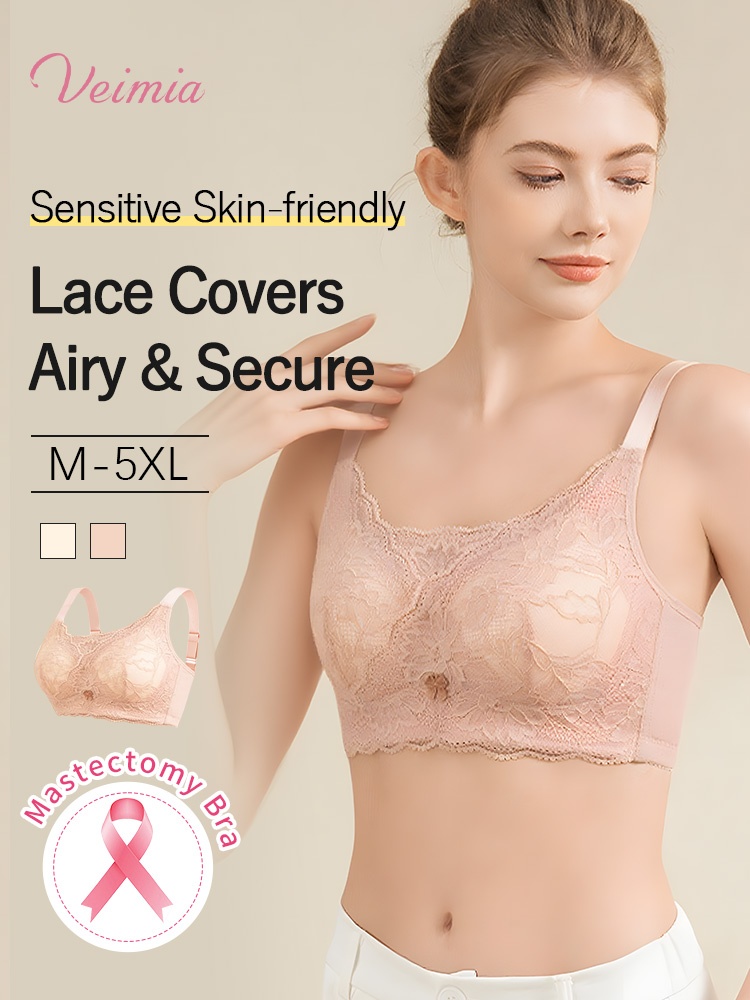
VEIMIA Wireless Cotton-Lined Mastectomy Bra
This style makes the inner surface the main consideration. Its current product specification lists a 100% cotton lining, alongside a wide prosthesis pocket and wireless construction.
Current SG price: S$49
- 100% cotton lining
- Wireless construction
- Wide prosthesis pocket
- Adjustable shoulder straps
- Back closure
- Sizes currently listed from M to 5XL
Cotton lining may appeal if the feel of the inside fabric is particularly important to you. Skin sensitivity varies, so judge the complete garment rather than fibre content alone.
View Cotton-Lined Option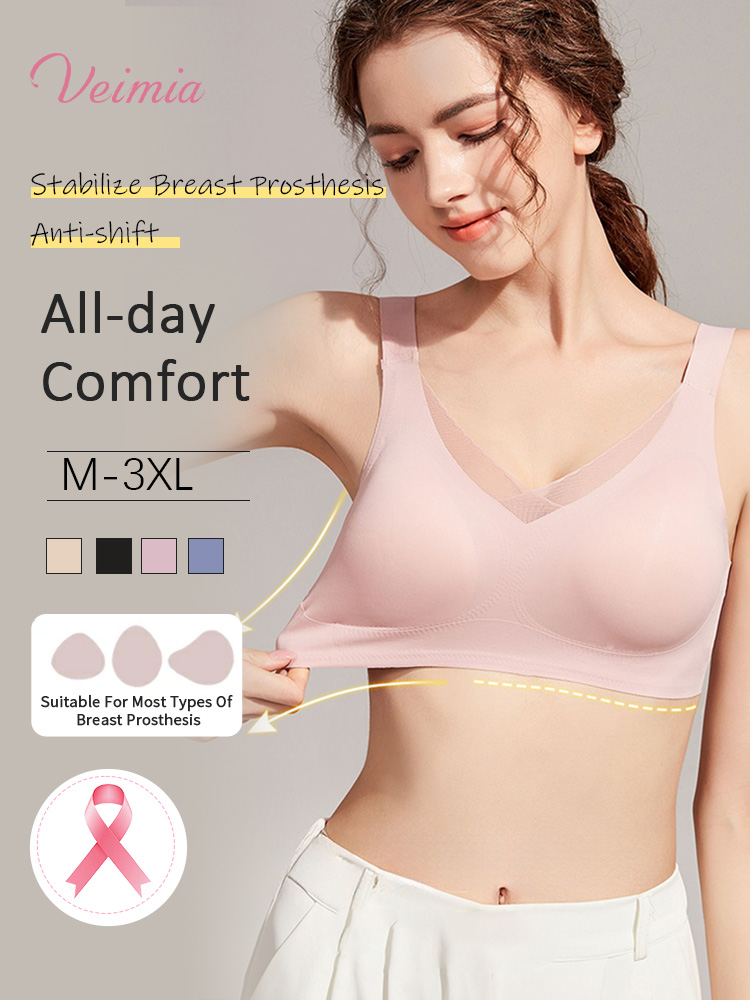
VEIMIA All-day Comfort Mastectomy Bra
This option places everyday breast-form containment and smooth wear at the centre, combining a dedicated prosthesis pocket with wireless, seamless construction and adjustable straps.
Current SG price: S$35
- Dedicated breast prosthesis pocket
- Wireless structure
- Seamless construction
- Adjustable shoulder straps
- Back closure
- Sizes currently listed from M to 3XL
Consider this type of feature set when stable everyday breast-form wear matters more to you than front fastening or cotton lining.
View All-day Comfort OptionCompare the VEIMIA Mastectomy Bra Collection
If you already know which features matter most—front fastening, cotton lining, breast-form pockets, wireless construction or everyday stability—you can compare the current collection by those needs rather than looking for a universal “best” bra.
Explore Mastectomy BrasA Good Feature List Cannot Fix the Wrong Fit
You can choose the softest fabric, most convenient closure and most thoughtfully designed pocket—and still end up uncomfortable if the bra does not fit.
Breast Cancer Now recommends having bra size checked because body shape and size may change during and after treatment.
If you use a breast prosthesis, fit becomes a relationship between three things:
Do not judge those three pieces independently.
Put them together, add a shirt you normally wear, then move.
Our Mastectomy Bra Fit Guide covers this process in more detail.
You Are Choosing Features, Not a New Identity
After breast surgery, it is easy for clothing to become filled with medical language.
But a bra still has an ordinary job.
It should work with your body, clothes and daily life.
You do not need a more complicated bra simply because a more complicated one exists.
And you do not need to choose the simplest bra if a pocket, front closure or cotton lining genuinely makes your day easier.
Choose by need, not by “best.”
The right features are the ones that solve something you actually experience.
From the VEIMIA Pinkbook Breast Care Series
→ What Bra Should You Wear After a Mastectomy? → Mastectomy Bra Fit Guide → Pocketed Mastectomy Bra Guide → Mastectomy Bra Climate GuideHow to Choose a Mastectomy Bra: Frequently Asked Questions
How do I choose a mastectomy bra?
Consider skin comfort, prosthesis pocket design, coverage, underband pressure, strap stability, closure type, breathability and how the bra feels during everyday movement. During surgical recovery, follow your clinical team's specific instructions first.
What should I look for in a mastectomy bra?
Look for features that match your own needs. These may include soft inner fabrics, smooth seams, a comfortable band, adjustable straps, prosthesis pockets, easy fastening and enough coverage to feel secure without rubbing.
What is the best bra after mastectomy?
There is no single best bra after mastectomy for everyone. The most suitable bra depends on your stage of recovery, skin comfort, breast-form use, mobility, clothing and personal preference.
Do I need a prosthesis pocket in my bra?
Only if it is useful to you. A pocket can help contain a breast form and keep fabric between the prosthesis and skin, but some breast forms can also be worn securely inside a well-fitting regular bra.
Is cotton better for a comfortable mastectomy bra?
Cotton may feel soft and breathable, especially if skin sensitivity is a concern, but fibre content is only one part of comfort. Seams, band pressure, fit, thickness and overall construction also matter.
Is a front closure better after mastectomy?
A front closure may be easier if reaching behind your body is difficult or shoulder movement is limited. It is a useful convenience feature rather than a requirement for every person after mastectomy.
How should a mastectomy bra fit with a breast prosthesis?
The bra should feel comfortable and stable, with enough cup space for the breast form without excessive compression or gaping. The form should remain reasonably secure when you sit, walk, bend and move.
Should a mastectomy bra be tight?
Unless your care team has specifically prescribed compression or a particular support level, a bra should not create painful pressure or dig into sensitive areas. The band should feel stable rather than restrictive.
Medical note: This guide provides general decision support rather than individual post-operative instructions. Surgery type, reconstruction, swelling, wound healing, radiotherapy and other treatment factors can affect which bra is appropriate. Follow advice from your surgeon or breast care nurse during recovery.