
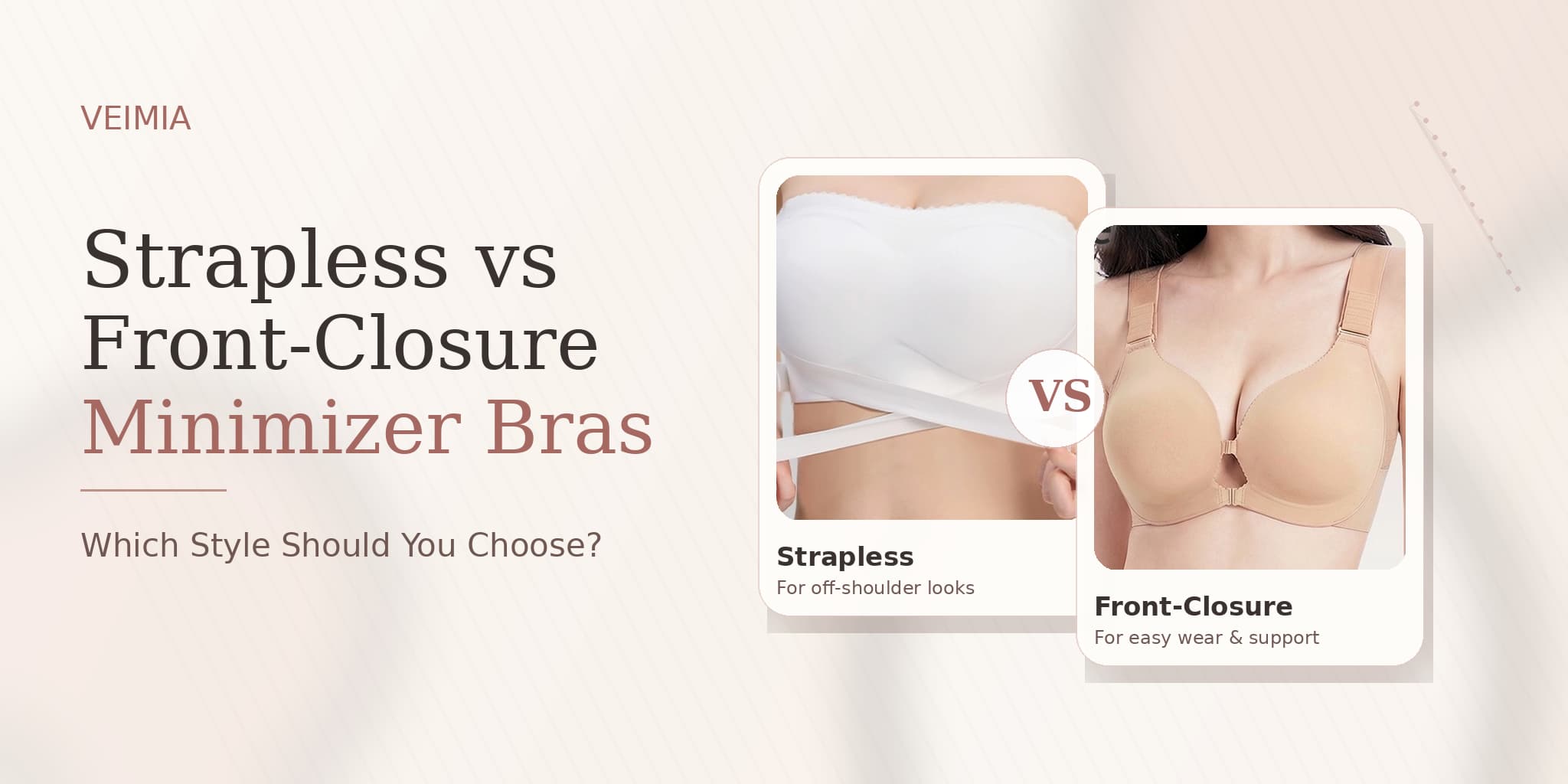
Strapless vs Front-Closure Minimizer Bras: Which Style Should You Choose?
Strapless and front-closure bras solve two completely different problems: one solves the outfit; the other solves the dressing process.
That is the most useful place to begin.
A strapless bra makes sense when visible shoulder straps would interfere with an off-shoulder dress, tube top or one-shoulder neckline. A front-closure bra makes sense when fastening the bra at the front feels simpler or more convenient than reaching behind.
Neither feature automatically means better support.
For a full bust, ask three questions in order: What does my outfit require? How easy is the bra to put on? How much stability do I need? The answer determines whether strapless, front closure or a standard fuller-coverage minimizer is the better choice.
Which sentence sounds most like you?
When does a strapless minimizer bra make sense?
Strapless makes sense when the neckline gives you a reason to remove shoulder straps.
Think off-shoulder dresses, tube tops, asymmetric necklines and evening pieces where ordinary straps would break the visual line of the outfit.
In this construction, the band becomes more important because the bra cannot rely on shoulder straps in the normal way.
A good strapless design therefore needs enough grip and band stability to stay in position without requiring you to keep pulling it upward throughout dinner.
Off-shoulder dress
Strapless is usually the most direct solution because the entire shoulder line remains visually clean.
Tube top
Prioritise grip and a stable band. The bra should remain in place without needing constant adjustment.
One-shoulder outfit
A strapless base avoids having to hide a standard strap beneath an asymmetrical neckline.
White occasion top
A smooth skin-adjacent shade and low-bulk cup can matter almost as much as the absence of shoulder straps.

VEIMIA Secure Strapless Bra
A purpose-built option for outfits where straps are the problem. The current design combines an all-around non-slip grip, detachable straps, an anti-slip band and ultra-thin one-piece pads, so it can move between fully strapless, standard-strap and cross-back styling.
Off-shoulder dresses, tube tops, one-shoulder looks, white tops and occasions where visible bra straps would interrupt the outfit.
The support strategy is built around grip and band security, while detachable straps give you more than one way to style it.
If your outfit fully covers ordinary straps and your first priority is maximum full-bust containment, there is little reason to sacrifice strap support just for the strapless feature.
When does a front-closure minimizer make more sense?
Front closure solves a different problem.
Instead of fastening hooks behind the body, a front closure minimizer bra brings the closure to a place you can see and reach directly.
For some women, that simply feels faster. For others, it removes the annoyance of twisting a bra around the torso after fastening it.
A front zip can also make taking the bra off at the end of a long day feel straightforward.
But the location of the closure does not, by itself, tell you how supportive the bra is.
You still need to judge:
- Band stability.
- Cup containment.
- Strap placement.
- Side coverage.
- Whether the front closure sits flat and comfortably.
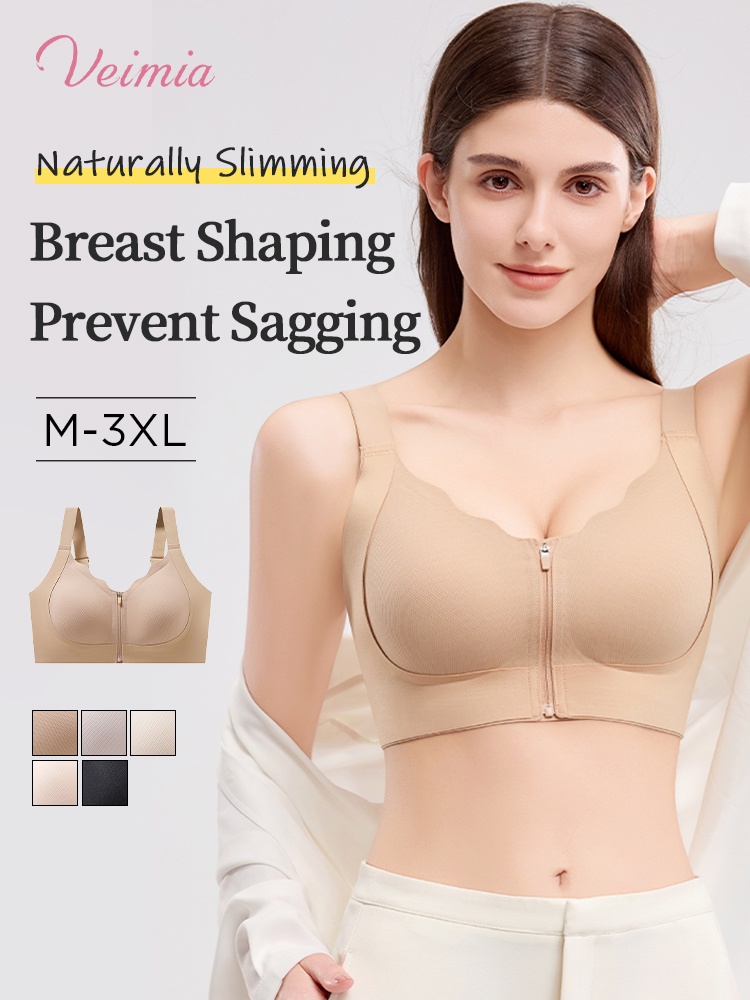
VEIMIA Supportive Front-Zip Minimizer
The easy-dressing option in this comparison. Its closure sits at the front, while the current PDP specifies wireless construction, adjustable shoulder straps and non-removable pads alongside the front zipper.
Anyone who prefers to see and reach the closure directly, dislikes fastening a bra behind the back, or simply wants a faster front-access dressing routine.
The front zipper is the defining convenience feature, while the rest of the bra still provides the cup and strap structure needed for everyday shaping.
If front fastening offers no practical benefit to you, choose by cup fit, stability or outfit compatibility instead. The closure alone is not a reason to buy a bra.
Which is more supportive: strapless or front closure?
There is no automatic winner because the two terms describe different parts of a bra.
“Strapless” tells you that the bra can work without ordinary shoulder straps. “Front closure” tells you where the bra fastens.
A front-closure bra can still have standard adjustable straps, so it may feel more familiar for everyday full-bust support.
A strapless bra, meanwhile, must rely much more heavily on band security, cup shape and grip.
If stability is your only criterion and your outfit does not require bare shoulders, a conventional strapped full-coverage design is often the simpler baseline to compare.
What should a full bust check before choosing strapless?
For a strapless bra for large breasts, start with the band.
Without ordinary shoulder straps, a loose band is far more obvious. The bra may slowly slide downward, roll or need repeated adjustment.
- Raise both arms above your head.
- Rotate your torso gently left and right.
- Sit down and stand back up.
- Lean forward slightly.
- Check whether the cup position and band remain broadly stable.
- Make sure the grip feels secure rather than painfully tight.
If you immediately want to pull the bra upward after those movements, the style or size may not provide the stability you need.
Also check cup containment. A strapless bra that stays up but allows significant top or side spillage is not giving you a successful fuller-bust fit.
Why does band fit matter even more in a strapless bra?
In a standard bra, straps help stabilise the top of the cups. In a strapless configuration, the band has to do more of that work.
This does not mean buying the smallest band you can tolerate.
An excessively tight band can become uncomfortable, roll at the edges or make an otherwise promising strapless bra difficult to wear through an entire occasion.
What you want is secure contact around the torso, supported by grip features and a cup that actually matches your breast volume.
For a fuller bust, the most stable strapless bra is usually the one that combines:
- A secure band.
- Effective anti-slip grip.
- Enough cup capacity.
- Controlled side coverage.
- No need for constant readjustment.
Which style is easier to put on and take off?
Front closure usually wins this specific category.
With a front zip minimizer bra, the fastening point is visible and accessible in front of the torso.
Strapless bras are not necessarily difficult to put on, but many still use a conventional back closure. Their main convenience is outfit versatility—not fastening access.
So if your decision is purely: “Which one is easier to fasten?”, front closure has the clearer advantage.
If the question is: “Which one disappears under my off-shoulder dress?”, strapless wins.
When NOT to choose this style
If your blouse or dress already covers regular straps and you need strong everyday stability, ordinary straps can be useful. There is no benefit in removing support you do not need to hide.
If the cup shape, band or zipper position does not suit you, convenience cannot compensate for poor fit. The closure should be an advantage, not the only advantage.
An occasion bra and an active-day bra solve different problems. If you expect a lot of movement, prioritise stability over a bare-shoulder feature you do not need.
Closure position affects dressing convenience. Cup containment, band stability, side control and straps determine whether the bra actually supports your full bust well.
When is neither strapless nor front closure the best choice?
When your main concern is simply: “I need my full bust to stay contained and stable all day.”
In that case, neither an exposed-shoulder feature nor a front zipper necessarily solves the problem you have.
A conventional full-coverage style keeps regular shoulder straps and can devote more of its design to cup containment, side support and movement control.
This can be the more logical choice for:
- Long workdays.
- High-coverage office outfits.
- Frequent walking or repeated movement.
- Softer breast tissue that benefits from more cup containment.
- Days when neckline compatibility is not a problem.
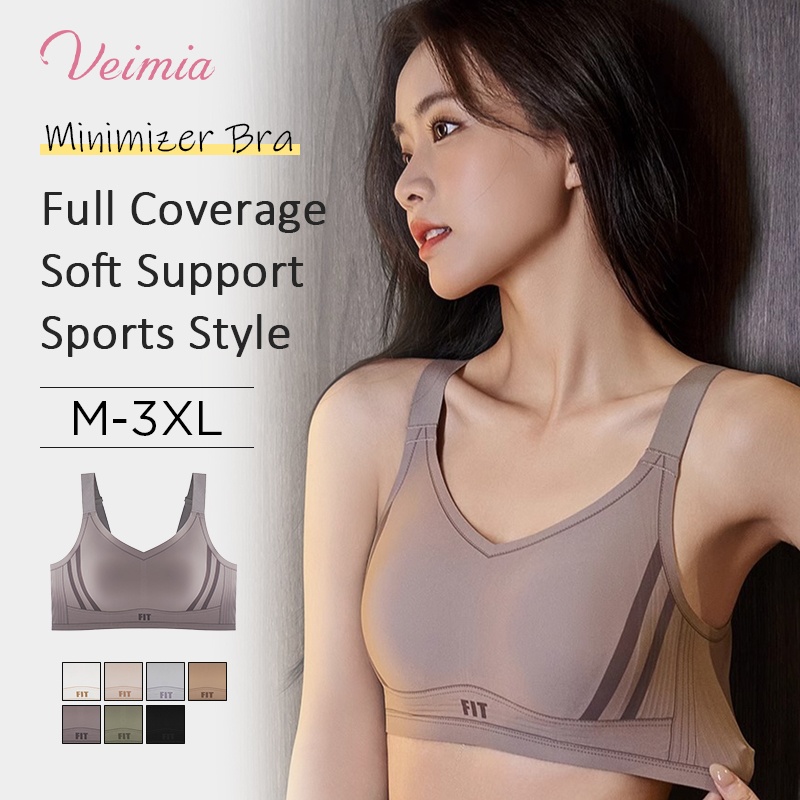
VEIMIA Sports Style Full Coverage Minimizer
This is the control option in the comparison. It does not try to solve a bare-shoulder neckline or front-access problem. Instead, its seamless full-coverage construction focuses on fuller-bust wrapping, broad support and stable everyday containment.
Women whose real priority is secure cup coverage, everyday movement and fuller-bust containment rather than a specialised closure or occasion neckline.
Regular straps, full coverage and a broad supportive structure keep the design centred on stability.
It is not the right answer when the outfit exposes your shoulders or when easy front fastening is the feature you specifically need.
Strapless vs front closure vs full coverage: quick comparison
The simplest comparison is to look at the job each construction is designed to do.
| Decision | Strapless | Front Closure | Standard Full Coverage |
|---|---|---|---|
| Main reason to choose | Bare-shoulder outfit compatibility | Easier front fastening | Stable everyday containment |
| Best outfit | Tube, off-shoulder or one-shoulder styles | Everyday clothing that covers the straps | T-shirts, workwear and higher-coverage clothing |
| Full-bust priority | Band and non-slip stability | Cup and band fit around the front closure | Cup containment and weight distribution |
| Dressing ease | Similar to a standard bra if back-fastened | Strong advantage | Conventional |
| Risk to watch | Slippage if the band or grip is not secure | Choosing for the zipper while ignoring fit | More coverage than a low neckline allows |
| Choose when... | “My outfit needs bare shoulders.” | “Front fastening makes dressing easier.” | “I mainly want secure support.” |
Pick the problem—not the bra name
Your outfit and dressing routine should tell you which feature is worth paying for.
Strapless vs Front-Closure Minimizer Bra FAQ
Can large breasts wear a strapless minimizer bra?
Yes. A fuller bust can wear a strapless minimizer when the band, cup capacity and anti-slip structure are stable enough for the wearer's breast shape and weight. Test the bra by raising your arms, sitting and moving before relying on it for an occasion.
Is a front closure minimizer bra easier to wear?
It can be easier to put on and remove because the fastening point is visible and reachable at the front of the body. This is a convenience advantage, not an automatic indication of stronger support.
Which works better for an off-shoulder dress?
Strapless is usually the more appropriate construction because it keeps the shoulder line free of visible straps. The band and cup fit need to be stable enough to support the bust without repeated adjustment.
Which is more stable: strapless or front closure?
Closure type alone does not determine stability. A front-closure bra with regular straps may feel more familiar for everyday support, while a strapless bra depends more heavily on band and grip stability. Correct fit matters most.
What keeps a strapless bra from slipping down?
A secure band, suitable cup fit and anti-slip or grip features can help the bra stay in position. The band should feel stable without being painfully tight.
Should I size down in a strapless bra for more support?
Do not automatically size down. Excessive tightness can create discomfort, cup overflow or rolling. Choose the size that gives secure band contact while still containing the bust correctly.
Is a front zip minimizer bra good for a full bust?
It can be if the cups, band, sides and straps fit the fuller bust correctly. The zipper provides easy access, while the rest of the bra still determines support and containment.
Is front closure better than back closure?
It is better when easy front access is important to you. It is not automatically superior for fit or support. If you have no difficulty with a back closure, compare the bras primarily by cup shape and support.
When should I choose a standard full-coverage minimizer instead?
Choose standard full coverage when your outfit does not require a strapless neckline and easy front fastening is not a priority, but secure cup containment and everyday stability are.
Which style is better for a date-night dress?
Match the bra to the dress. Strapless works best when the dress exposes the shoulders; front closure only matters if easier dressing is useful and the dress covers the straps. For a higher-neck fitted dress, a seamless or full-coverage minimizer may be the better solution.
Bra stability varies with breast shape, breast weight, band fit, cup capacity and individual comfort. Strapless and front-closure recommendations in this guide are scenario-based decision aids rather than universal fit guarantees.